Oops!
If you're seeing this, you'll need to:
Click Here to Refresh
or swipe down to refresh...
Still not working?
Check your Internet connection or restart your phone
Need more help?
Email us at
support@hipcomic.com
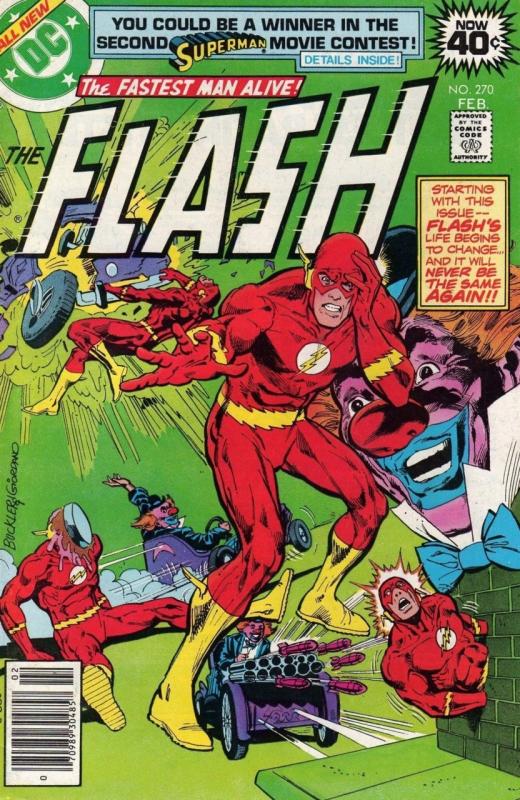
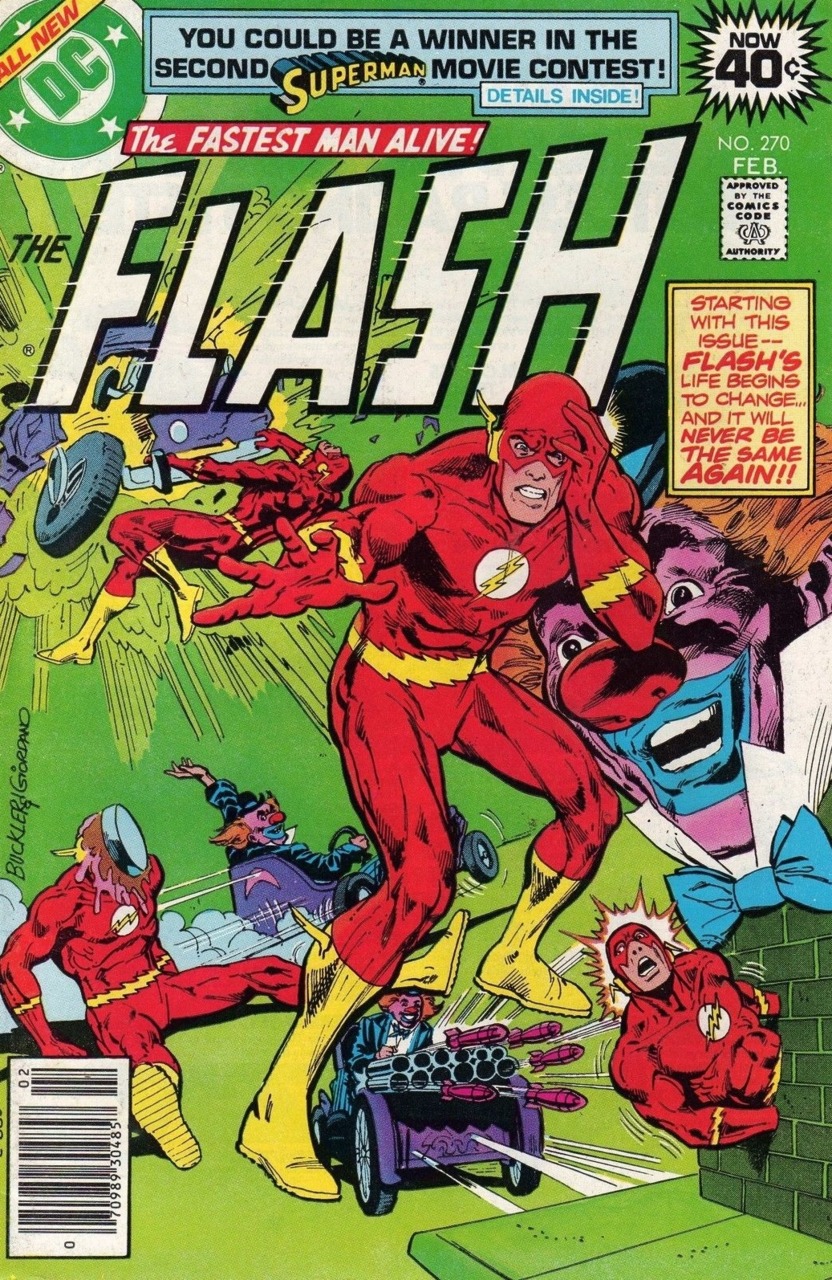
The Flash #270 A Fast Way To Die!
Cover Date: February, 1979
Returning to Central City, from a morning jog across the continents, the Flash encounters a robbery, being perpetrated by a clown. Alerted to the Flash's presence by one of the incapacitated police officers, the clown goes on the offensive. The clown lau ...
Issue Description
Returning to Central City, from a morning jog across the continents, the Flash encounters a robbery, being perpetrated by a clown. Alerted to the Flash's presence by one of the incapacitated police officers, the clown goes on the offensive. The clown launches his pogo stick at the Flash, then flees in an old jalopy. The Flash easily fends off the clown's attack, quickly catching up to him. The shell of the jalopy falls away, revealing a souped up hot rod. Locking onto the Flash's heat signature, the discarded pieces of the jalopy come barreling towards him. Vibrating his molecules into intangibility, the Flash dives beneath the street, to avoid the collision.
Without missing a beat, the Flash resumes his pursuit. Just as the Flash is about to lay hands on the clown, he is pied in the face. The pie is saturated with ether, knocking the Flash out. A mysterious figure makes plans to steal 15 ounces of heroin from the evidence room, at police headquarters. The Flash, as police forensics scientist, Barry Allen, is called into a meeting with the Chief of Detectives, Captain Harvey Paulson. Allen learns that his graduate thesis paper has become the guiding inspiration for the Nephron Process. Allen is ordered to attend a meeting with Professor Gilbert Nephron, at the state penitentiary.
Allen calls home to break his dinner plans, incurring the wrath of his wife, Picture News reporter, Iris West. A mysterious woman looks over her shrine to the Flash, bemoaning the fact that she doesn't know what the Flash looks like underneath his mask. Allen arrives at the penitentiary, and attends a demonstration on aversion therapy. Nephron believes that criminals can be programmed to feel an abject aversion towards criminal acts, thus ending their threat to society. Allen has his doubts. Nephron's demonstration is broadcast to every cell in the prison. At the end of his lecture, Nephron asks for volunteers, from the prison populace, to undergo his process.
Any man that does will be granted a full pardon, by the governor, regardless of his crimes. Only one man volunteers, murderer Clive Yorkin. At police headquarters, a pair of shadowy figures move the heroin, from the evidence lock-up to Allen's laboratory, disguising it among the bottles of chemicals. The next morning, Allen finds his wife is still not speaking to him. En route to work, Allen, as the Flash, sees a large, gaseous "HA HA" floating over the city. Further investigation leads to a steam powered calliope, rolling down the street. The Flash spies a tuft of the clown's hair beneath a manhole cover. Creating a powerful updraft, at super-human speed, the Flash pulls the clown from the sewers.
As the clown is lifted into the air, the Flash notes that he's attached to a coiled metal spring. As he rises higher into the air, a cluster of dynamite, tangled in the coil, reaches street level, and detonates. The Flash is able to avoid the primary explosion, but finds himself caught in the blast wave. Vibrating his molecules at super-human speed, the Flash is able to partially slip through a brick wall, instead of slamming into it. With the molecules of his legs merged with that of the brick wall, the Flash is a sitting target. A fact the clown takes advantage of, by firing missiles at the Flash, from the cannon-like pipes of the calliope.
The Flash (1959)
- Publisher
- DC Comics
Volume Description
The Flash Volume 1, (continued from Flash Comics).
House AdStarring Barry Allen as the Flash and Wally West as Kid Flash. After 4 try-out issues of "Show case" - the first being #4, which is widely accepted as being the comic that launched the Silver Age - the Flash returned to star in his own title with #105 in 1959. The numbering of the title continued from the Golden Age "Flash Comics," which had come to an end as Super Heroes went out of fashion in the early 1950's. When Police scientist Barry Allen was doused with a variety of chemicals along with a bolt of lightning, the accident endowed him with Super Speed, and he donned the famous red Flash uniform we are all familiar with. Barry was seeing reporter Iris Allen, and to ensure he kept his identity as the Flash a secret from his girlfriend, he always turned up late for their dates. During his Showcase appearances, the Flash had battled the first of what was to become his rogues gallery when he clashed with Captain Cold, and his range of costumed opponents was about expand almost as rapidly as his uniform expanded from his ring when it came into contact with air. In his opening issue, the Flash battled the Mirror Master, and in the following issue, readers were introduced to Gorilla Grodd, Solovar, and the inhabitants of Gorilla City in a trilogy of tales that ran through issues #106 - 108. Also starring in #106 was another costumed villain, the Pied Piper. The Mirror Master obviously proved a hit with fans as he was back in #109 for a re-match and in #110 the Flash encountered the Weather Wizard for the first time. The Trickster brought his tricks to Central City in Flash #113, while Captain Cold returned in #114 and another Captain - this time Captain Boomerang debuted in #117.
However, it wasn't just super villains the Flash was encountering in the early issues of his own series. In #110, Kid Flash made his debut, when Wally West was caught in a freak duplicate of the accident that had given Barry his super speed. Wally's original costume was a duplicate of Barry's (only smaller of course) but sidekicks were "in" at the time and Wally would often feature in back up stories in the Flash as well as sometimes teaming up with his mentor - such as in #120. Later (#135) Wally would receive his more familiar yellow and red costume, which would serve him for the best part of two decades. Shortly after the introduction of Kid Flash, the Flash encountered Ralph Dibny, the Elongated Man in #112. At first, Barry thought the Elongated Man was a criminal, but by the end of the lead story in this issue, Ralph was exonerated, and the two men became firm friends. Editor Julius Schwartz was developing a number of friendships across the books he edited and chief among them was a friendship between Green Lantern and the Flash. The two first teamed up in Green Lantern #13 and the friendship was cemented during several shared adventures including the ones in Flash #131 and #143.
The most far reaching team -up of Barry's career was to come about in the classic Flash #123, "Flash of Two Worlds" in which the Scarlet Speedster met his "hero" Jay Garrick, the original Flash from the Golden Age of comics, and the concept of Earth Two was launched. Subsequent team ups between the two Flashes included the reintroduction of the Justice Society of America in #137's "Vengeance of the Immortal Villain," as the heroes pitted their wits against Vandal Savage. In the meantime, the villains just kept coming, as Abra Kadabra - a magician from the future made his debut in #128, Heat Wave made things hot for the Flash in #140, and the Top put him in a spin in # 141. However, it was the introduction of Eobard Thawne - the Reverse Flash (or Professor Zoom) in #140 that would have the most far reaching and long lasting effect upon Barry Allen's future.
When Barry and Iris finally got around to tying the knot, (#165), the Reverse Flash tried to take his place at the altar. Although Barry foiled his arch -foe on this occasion, history would repeat itself later in the series. After the death of Iris (accidentally shot at a costume ball), Barry was about to get re-married. Thawne was about to kill his fiance, but in order to prevent that happening, Barry snapped the neck of his enemy - an event which led to the two-year plus "Trial of the Flash," which concluded the series and led to the seeming demise of Barry Allen in Crisis on Infinite Earths.
With science-based stories by the likes of Gardner Fox, John Broome, and Robert Kanigher, and the sleek angular artistic lines provided by Carmine Infantino, the Flash became one of the most popular and attractive books in the DC line throughout the Silver Age and indeed its impressive 246 issue run. The series ended with issue 350 and was continued a little more over a year into The Flash Volume 2.
Collected EditionsFlash Archives Vol. 1 (#105-108)Flash Omnibus (#105-132)Showcase Presents: The Flash vol. 1 (#105-111)Flash Archives Vol. 2 (#109-116)Flash Archives Vol. 3 (#117-124)Showcase Presents: The Flash vol. 2 (#120-140)Flash Archives Vol. 4 (#125-132)Flash Archives Vol. 5 (#133-141)Showcase Presents: The Flash vol. 3 (#141-161)Flash Archives Vol. 6 (#142-150)Showcase Presents: The Flash vol. 4 (#162-184)Absolute Green Lantern/Green Arrow (#217-219 & 226)Showcase Presents: The Trial of the Flash (#323-7, 329-336, 340-350)Please first Sign In before leaving a review.