Oops!
If you're seeing this, you'll need to:
Click Here to Refresh
or swipe down to refresh...
Still not working?
Check your Internet connection or restart your phone
Need more help?
Email us at
support@hipcomic.com
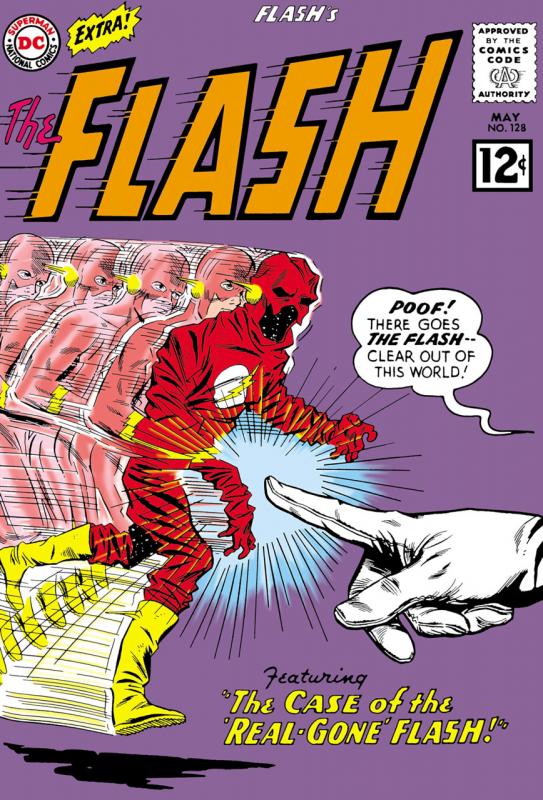
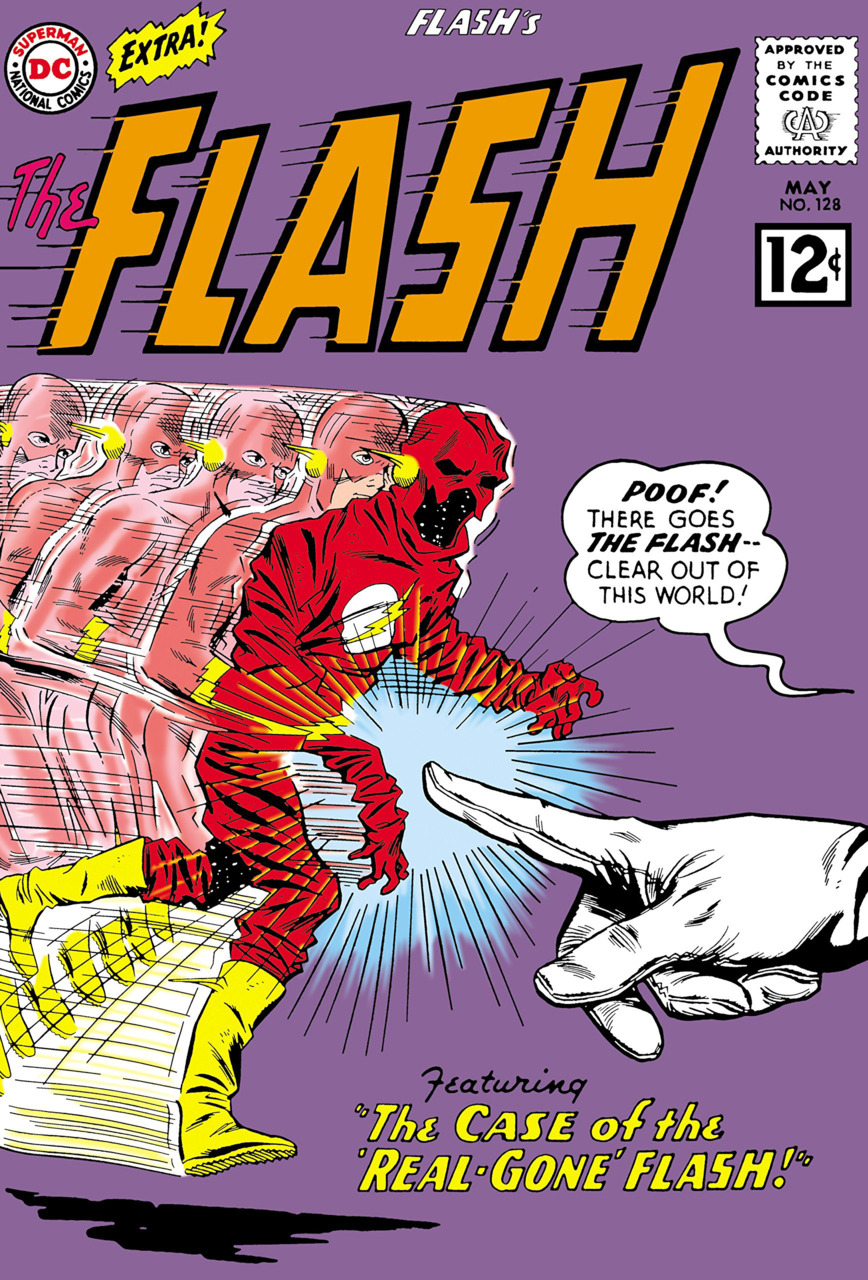
The Flash #128 The Case of the Real-Gone Flash
Cover Date: May, 1962
Featuring the first appearance of Abra Kadabra, a magician from the 64th century who travels to the past and becomes a criminal.The Case Of The Real-Gone Flash! In the year 6363, advances in science have made magicians obsolete. One such magician, Abra K ...
Issue Description
Featuring the first appearance of Abra Kadabra, a magician from the 64th century who travels to the past and becomes a criminal.
The Case Of The Real-Gone Flash!In the year 6363, advances in science have made magicians obsolete. One such magician, Abra Kadabra, bemoans the fact that he can't find work. Craving applause, Abra Kadabra practices his tricks, alone in his room, while listening to recorded applause. Learning that scientists have just invented a time machine, Abra Kadabra sees an opportunity to change his life. Using the Hypno-Ray, concealed in the gem-flower of his lapel, Abra Kadabra paralyzes the scientists. Using the time machine, Abra Kadabra journeys to Central City, in the year 1962. The time machine is destroyed upon arrival, leaving Abra Kadabra stranded in the past. Spying a crowd of bystanders, Abra Kadabra begins performing tricks for them.
Though impressed with his performance, the crowd isn't responding the way Abra Kadabra would prefer. Using his Hypno-Ray, Abra Kadabra forces the crowd to thunderously applaud him. The applause of the small crowd , though, is not enough to suit Abra Kadabra's ego. Renting a concert hall, Abra Kadabra plans to perform for thousands, but his audience is stolen away by the World Series. Scanning the week's upcoming events, Abra Kadabra finds too much competition for his performance. Looking over the Flash's exploits, in the local paper, Abra Kadabra decides that the only way to make headlines is to steal them. Appearing at the unveiling of a statue symbolizing American freedom, Abra Kadabra uses future technology to cause the statue to disappear.
Abra Kadabra uses his Hypno-Ray to paralyze his "audience", to prevent anyone from pursuing him. Among the paralyzed spectators is police forensics scientist, Barry Allen. Unable to move, Allen cannot go into action, as the Flash. Though Abra Kadabra makes all of the headlines in the following days' papers, he is dissatisfied with the "performance", due to the lack of applause. Allen correctly guesses where Abra Kadabra will strike next, and goes to confront him, as the Flash. Sure enough, the Flash arrives at the Central City Library, just in time to see Abra Kadabra make a valuable book disappear. Once more, Abra Kadabra employs his Hypno-Ray to force everyone to applaud his actions, including the Flash.
To prevent the Flash from pursuing him, Abra Kadabra also commands him to stamp his feet in approval. Determining the Flash to be the only real threat to his continued operation in Central City, Abra Kadabra plots to rid the town of the Scarlet Speedster. Renting out a concert hall, Abra Kadabra offers to give a public performance. When the Flash arrives to arrest him, Abra Kadabra uses his future technology to launch the Flash into orbit. To the audience's eyes, the Flash just seems to disappear, leaving behind his costume. Taking the costume as a souvenir, Abra Kadabra exits the concert hall, to the forced thunderous applause of his captive audience. Though helplessly rocketing through space, the scientist in Allen can't help marveling at the star filled void's majesty.
A small planetoid's gravity draws Allen down. Allen races at super-speed around the planetoid, until he reaches escape velocity. Allen then launches himself back at Earth, arriving safely in Central City. Attuning his vibrational frequency to the same radiation wavelength Abra Kadabra used to hurl him into space, Allen follows the residual radiation, still clinging to his costume, to Abra Kadabra's location. Vibrating through the wall and into his costume, Allen attacks Abra Kadabra, as the Flash. Abra Kadabra activates the paralyzing power of his Hypno-Ray. The Flash is moving so fast that not only is he able to easily dodge the beam, but he also grabs Abra Kadabra and pushes him into the beam, paralyzing him. Stiff as a board, Abra Kadabra is carried off to jail.
The Origin Of Flash's Masked Identity!Having recently gained his fantastic super-speed powers, police forensics scientist, Barry Allen, considers going sans mask, as the Flash. Addressing the National Science Convention, Allen reveals that he is the Flash. Allen is just about to demonstrate his powers, when he is alerted to a tornado, on the outskirts of Central City. Moving at super-speed, Allen, as the Flash, generates a counter-rotation, which dissipates the tornado. Arriving at work the next day, Allen is mobbed by a crowd of admirers. No sooner has Allen finally made into his laboratory, at police headquarters, then he is alerted to a burglary in progress.
Allen races into action, as the Flash. Exiting police headquarters, the Flash finds that the crowd outside has tripled in size. Losing precious seconds navigating the crowd, the Flash arrives at the scene of the crime, too late to prevent the theft. Having spied a car departing the museum as he arrived, the Flash takes a chance and pursues it. Sure enough, it's the getaway car. The Flash generates a mound of compressed air beneath the car, and carries it, and the thieves, to the nearest police station. Allen awakes from his daydream. Realizing that revealing his identity would create unnecessary obstacles in his crime-fighting career as the Flash, Allen decides to add the mask to his costume.
The Flash (1959)
- Publisher
- DC Comics
Volume Description
The Flash Volume 1, (continued from Flash Comics).
House AdStarring Barry Allen as the Flash and Wally West as Kid Flash. After 4 try-out issues of "Show case" - the first being #4, which is widely accepted as being the comic that launched the Silver Age - the Flash returned to star in his own title with #105 in 1959. The numbering of the title continued from the Golden Age "Flash Comics," which had come to an end as Super Heroes went out of fashion in the early 1950's. When Police scientist Barry Allen was doused with a variety of chemicals along with a bolt of lightning, the accident endowed him with Super Speed, and he donned the famous red Flash uniform we are all familiar with. Barry was seeing reporter Iris Allen, and to ensure he kept his identity as the Flash a secret from his girlfriend, he always turned up late for their dates. During his Showcase appearances, the Flash had battled the first of what was to become his rogues gallery when he clashed with Captain Cold, and his range of costumed opponents was about expand almost as rapidly as his uniform expanded from his ring when it came into contact with air. In his opening issue, the Flash battled the Mirror Master, and in the following issue, readers were introduced to Gorilla Grodd, Solovar, and the inhabitants of Gorilla City in a trilogy of tales that ran through issues #106 - 108. Also starring in #106 was another costumed villain, the Pied Piper. The Mirror Master obviously proved a hit with fans as he was back in #109 for a re-match and in #110 the Flash encountered the Weather Wizard for the first time. The Trickster brought his tricks to Central City in Flash #113, while Captain Cold returned in #114 and another Captain - this time Captain Boomerang debuted in #117.
However, it wasn't just super villains the Flash was encountering in the early issues of his own series. In #110, Kid Flash made his debut, when Wally West was caught in a freak duplicate of the accident that had given Barry his super speed. Wally's original costume was a duplicate of Barry's (only smaller of course) but sidekicks were "in" at the time and Wally would often feature in back up stories in the Flash as well as sometimes teaming up with his mentor - such as in #120. Later (#135) Wally would receive his more familiar yellow and red costume, which would serve him for the best part of two decades. Shortly after the introduction of Kid Flash, the Flash encountered Ralph Dibny, the Elongated Man in #112. At first, Barry thought the Elongated Man was a criminal, but by the end of the lead story in this issue, Ralph was exonerated, and the two men became firm friends. Editor Julius Schwartz was developing a number of friendships across the books he edited and chief among them was a friendship between Green Lantern and the Flash. The two first teamed up in Green Lantern #13 and the friendship was cemented during several shared adventures including the ones in Flash #131 and #143.
The most far reaching team -up of Barry's career was to come about in the classic Flash #123, "Flash of Two Worlds" in which the Scarlet Speedster met his "hero" Jay Garrick, the original Flash from the Golden Age of comics, and the concept of Earth Two was launched. Subsequent team ups between the two Flashes included the reintroduction of the Justice Society of America in #137's "Vengeance of the Immortal Villain," as the heroes pitted their wits against Vandal Savage. In the meantime, the villains just kept coming, as Abra Kadabra - a magician from the future made his debut in #128, Heat Wave made things hot for the Flash in #140, and the Top put him in a spin in # 141. However, it was the introduction of Eobard Thawne - the Reverse Flash (or Professor Zoom) in #140 that would have the most far reaching and long lasting effect upon Barry Allen's future.
When Barry and Iris finally got around to tying the knot, (#165), the Reverse Flash tried to take his place at the altar. Although Barry foiled his arch -foe on this occasion, history would repeat itself later in the series. After the death of Iris (accidentally shot at a costume ball), Barry was about to get re-married. Thawne was about to kill his fiance, but in order to prevent that happening, Barry snapped the neck of his enemy - an event which led to the two-year plus "Trial of the Flash," which concluded the series and led to the seeming demise of Barry Allen in Crisis on Infinite Earths.
With science-based stories by the likes of Gardner Fox, John Broome, and Robert Kanigher, and the sleek angular artistic lines provided by Carmine Infantino, the Flash became one of the most popular and attractive books in the DC line throughout the Silver Age and indeed its impressive 246 issue run. The series ended with issue 350 and was continued a little more over a year into The Flash Volume 2.
Collected EditionsFlash Archives Vol. 1 (#105-108)Flash Omnibus (#105-132)Showcase Presents: The Flash vol. 1 (#105-111)Flash Archives Vol. 2 (#109-116)Flash Archives Vol. 3 (#117-124)Showcase Presents: The Flash vol. 2 (#120-140)Flash Archives Vol. 4 (#125-132)Flash Archives Vol. 5 (#133-141)Showcase Presents: The Flash vol. 3 (#141-161)Flash Archives Vol. 6 (#142-150)Showcase Presents: The Flash vol. 4 (#162-184)Absolute Green Lantern/Green Arrow (#217-219 & 226)Showcase Presents: The Trial of the Flash (#323-7, 329-336, 340-350)Please first Sign In before leaving a review.