Oops!
If you're seeing this, you'll need to:
Click Here to Refresh
or swipe down to refresh...
Still not working?
Check your Internet connection or restart your phone
Need more help?
Email us at
support@hipcomic.com
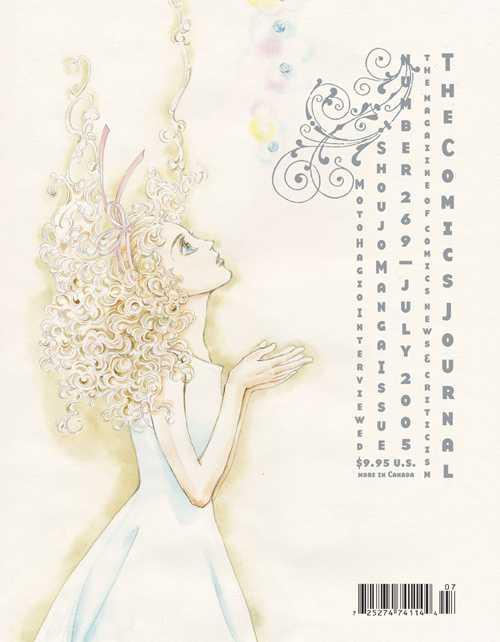
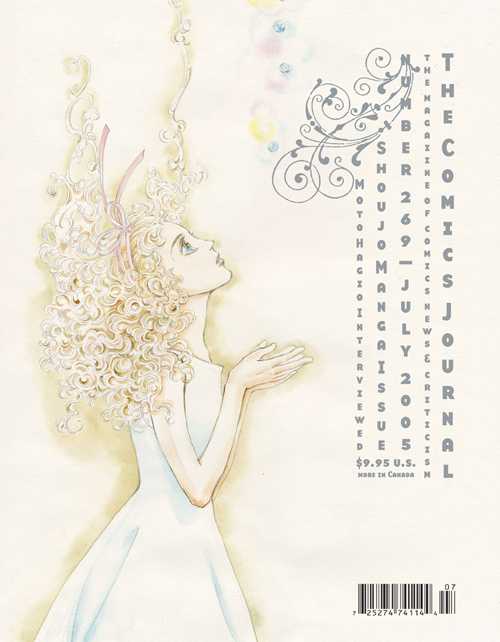
The Comics Journal #269
Cover Date: July, 2005
"Girls don't like comics." It was one of the hoariest clichés of the last 15 years in the American comics industry, but in the last three years, Japanese manga has exposed it for the lie it always was. Shoujo manga — women's comics — have become the ...
Issue Description
"Girls don't like comics." It was one of the hoariest clichés of the last 15 years in the American comics industry, but in the last three years, Japanese manga has exposed it for the lie it always was. Shoujo manga — women's comics — have become the engine driving the Asian comics invasion, and have amassed a large and enthusiastic female following. The Comics Journal #269 is devoted to exploring and explaining the phenomenon. Our cover interview spotlights pioneering shoujo cartoonist Moto Hagio, often called "the Osamu Tezuka of women's manga," who is renowned both for her psychologically challenging stories and as the originator of the "shonen-ai" (boy love) subgenre. Hagio was one of the ringleaders of the Magnificent 24-Year Group, a loose confederation of female manga creators who challenged the then-male-dominated shoujo industry in the early 1970s and left it utterly transformed. Scholar and translator Matt Thorn sits down for a long and fascinating conversation with Hagio in her first full-length interview ever, and also contributes an essay explaining who the 24-Year Group were and why their influence is still felt today. As if that weren't enough, we also present the first-ever English translation of Hagio's seminal short story "Hanshin," which has been studied by Japanese scholars and even adapted into a Japanese theater production! Also: Journalist Kai-Ming Cha traces the rise of shoujo as a market force in Asia and the United States; cartoonist Lea Hernandez explains how shoujo shaped her view of comics as an art form; cartoonist and historian Trina Robbins examines all-ages manga for girls; TCJ Managing Editor Dirk Deppey offers a theory as to why such boys' manga titles as Chobits, Love Hina and Negima have developed such strong followings among female readers; Kristy Valenti looks at the growing popularity of yaoi and shonen-ai comics; and our critics review a wide array of shoujo titles for your edification. If you're a Marvel executive trying to figure out how to break into the market, a retailer trying to make sense of the new paradigm in comics, or a reader wondering what all the fuss is about, you dare not miss this issue of the Journal.
The Comics Journal (1976)
- Publisher
- Fantagraphics
Volume Description
The Comics Journal is a magazine that covers the comics medium from an arts-first perspective, and one of the nation's most respected single-arts magazines, providing its readers with an eclectic mix of industry news, commentary, professional interviews, classic comics sections and reviews of current work on a regular basis. Due to its reputation as the American magazine with an interest in comics as an art form, the Journal has subscribers worldwide, and in this country serves as an important window into the world of comics for several general arts and news magazines.
Despite a contentious relationship with the rest of the North American comics industry, due in no small part to its investigative news stories and uncompromising review section, the Journal has won several industry awards, most notably the Utne Reader, Eisner and Harvey trophies.
In October 2009, we announced the next phase of the evolution of The Comics Journal, beginning in 2010 as a uniquely sized and formatted, evocatively visual and tactile semi-annual event, with expanded content at The Comics Journal website TCJ.com.
A comics magazine, which originally began as the New Nostalgia Journal, started in 1976 by Gary Groth and Mike Catron after the Nostalgia Journal (which ran 26 issues) lost their battle against the competing adzine, The Buyer's Guide. Gary and Mike, both in their twenties, had no plan, but somehow convinced the maker of the Nostalgia Journal to give them the paper.
As Gary Groth recalls:
I can’t remember how we talked them into this, but I suspect they were on their last legs and decided to hell with it, let’s give it to these two kids. Shortly thereafter, a box arrived in the mail with some back issues, a list of advertisers and a mailing list, and we were the proud new owners of Journal.
Please first Sign In before leaving a review.