Oops!
If you're seeing this, you'll need to:
Click Here to Refresh
or swipe down to refresh...
Still not working?
Check your Internet connection or restart your phone
Need more help?
Email us at
support@hipcomic.com
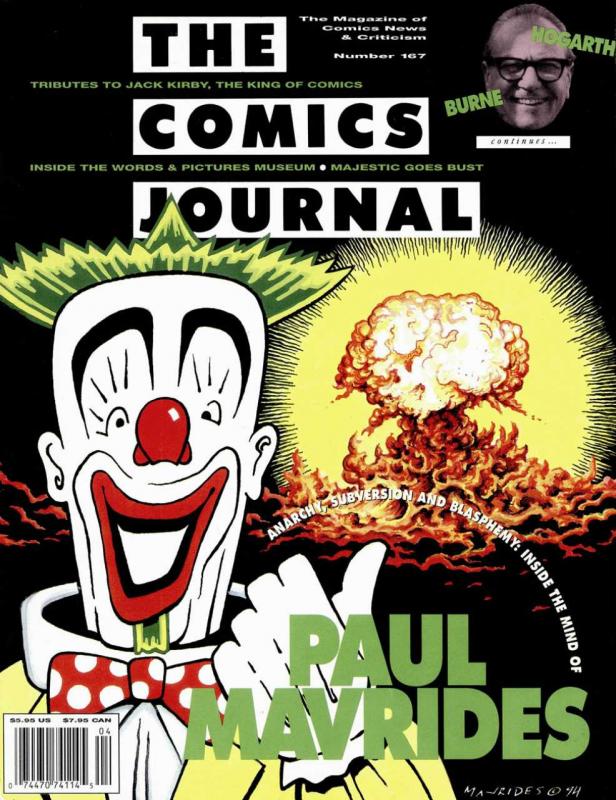
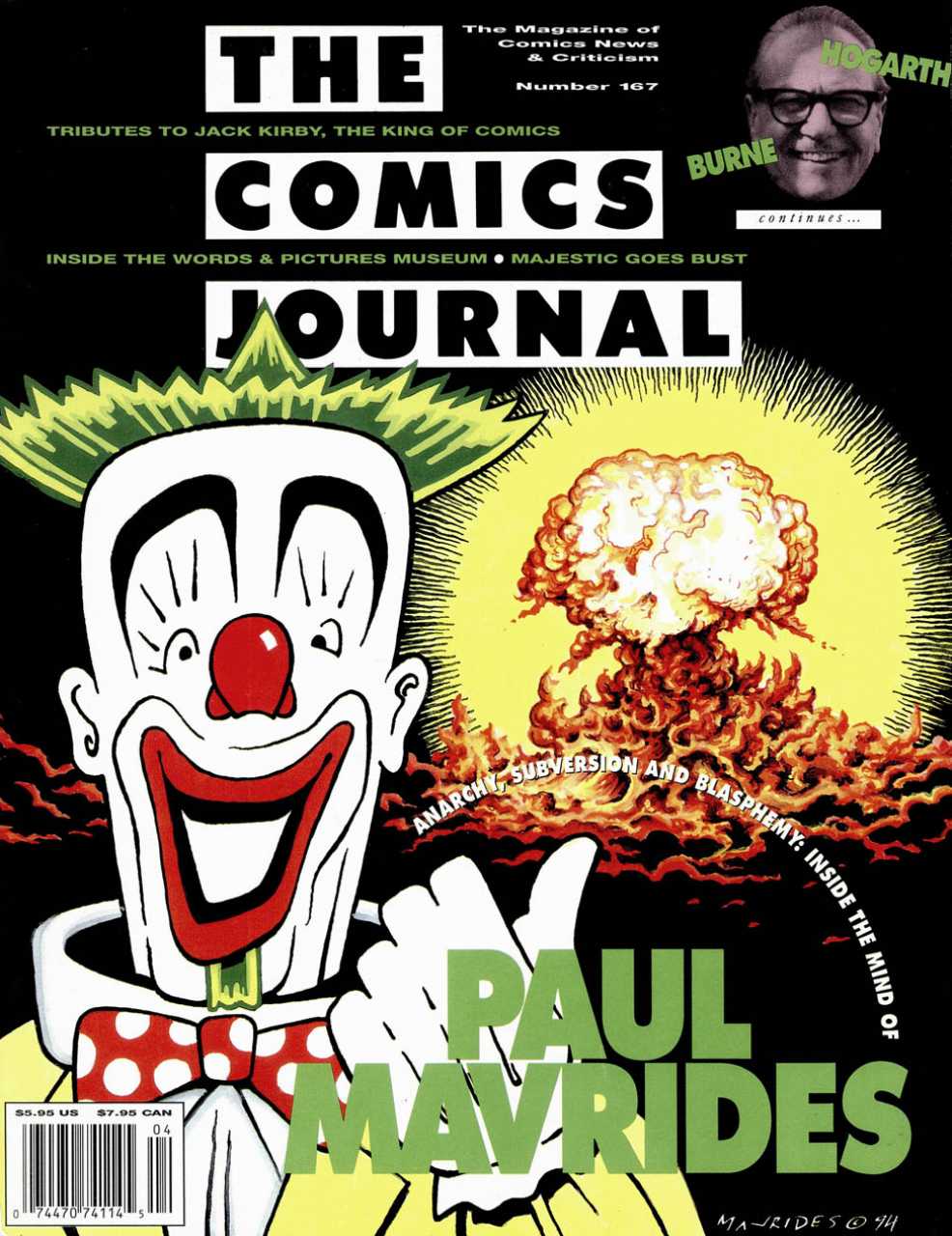
The Comics Journal #167
Cover Date: May, 1994
A two-sided flip-book issue. On one side: Who is Paul Mavrides? The Comics Journal tells all in April 1994, but to give you a hint, he happens to be the lone cartoonist taking on the California State Tax Board's landmark decision that comic books are not ...
Issue Description
A two-sided flip-book issue. On one side: Who is Paul Mavrides? The Comics Journal tells all in April 1994, but to give you a hint, he happens to be the lone cartoonist taking on the California State Tax Board's landmark decision that comic books are not artistic expression. Need more? How 'bout: The Church of the SubGenius, The Fabulous Furry Freak Brothers in "The Idiots Abroad," graphic design for director Alex Cox, Anarchy Comics, RE/SEARCH, The New Yorker, velvet paintings, The Realist, American Splendor, gum cards, Village Voice, Heavy Metal, and High Times? If you want to hear from a man behind the scenes on all these phenomena, pick up The Comics Journal #167. You'll also find the second and concluding half of the definitive interview with Burne Hogarth, creator of Dynamic Anatomy and Tarzan in the comics!
On the other side: Remembering Jack Kirby. Reminiscences, tributes and critical commentary from Will Eisner, Neil Gaiman, Paul Chadwick, Steve Rude, Chester Brown, Rick Veitch, Don Heck, Joe Sinnott, Jim Woodring, Marie Severin, Alan Moore, R.C. Harvey, Mark Schultz, Alex Toth, Richard Corben, Stan Lee and many more, with a cover portrait by Jaime Hernandez.
The Kirby tribute and the Mavrides and Hogarth interviews may be issue #167's features, but the real star of TCJ remains the range of regular features that mark it as the industry's best all-around magazine. The Journal's Newswatch section is the only source of real journalism on comic books, one that keeps readers who care deeply about the art of comics informed on the business and legal decisions that affect the entire industry. Plus, the Journal's review section is the only place you'll find people who take comics seriously discussing what comics are and what comics can be. And the Journal's "Hit List" section provides a reliable guide for sifting through the mass of comics junk — to help you find the good stuff. The only logical conclusion: keep up with The Comics Journal, and keep up with the state of the art in comics.
The Comics Journal (1976)
- Publisher
- Fantagraphics
Volume Description
The Comics Journal is a magazine that covers the comics medium from an arts-first perspective, and one of the nation's most respected single-arts magazines, providing its readers with an eclectic mix of industry news, commentary, professional interviews, classic comics sections and reviews of current work on a regular basis. Due to its reputation as the American magazine with an interest in comics as an art form, the Journal has subscribers worldwide, and in this country serves as an important window into the world of comics for several general arts and news magazines.
Despite a contentious relationship with the rest of the North American comics industry, due in no small part to its investigative news stories and uncompromising review section, the Journal has won several industry awards, most notably the Utne Reader, Eisner and Harvey trophies.
In October 2009, we announced the next phase of the evolution of The Comics Journal, beginning in 2010 as a uniquely sized and formatted, evocatively visual and tactile semi-annual event, with expanded content at The Comics Journal website TCJ.com.
A comics magazine, which originally began as the New Nostalgia Journal, started in 1976 by Gary Groth and Mike Catron after the Nostalgia Journal (which ran 26 issues) lost their battle against the competing adzine, The Buyer's Guide. Gary and Mike, both in their twenties, had no plan, but somehow convinced the maker of the Nostalgia Journal to give them the paper.
As Gary Groth recalls:
I can’t remember how we talked them into this, but I suspect they were on their last legs and decided to hell with it, let’s give it to these two kids. Shortly thereafter, a box arrived in the mail with some back issues, a list of advertisers and a mailing list, and we were the proud new owners of Journal.
Please first Sign In before leaving a review.