Oops!
If you're seeing this, you'll need to:
Click Here to Refresh
or swipe down to refresh...
Still not working?
Check your Internet connection or restart your phone
Need more help?
Email us at
support@hipcomic.com
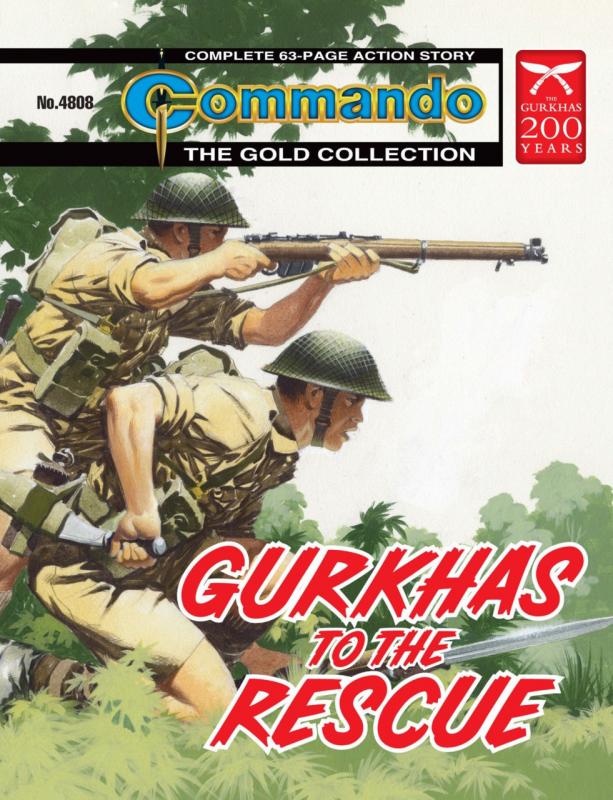
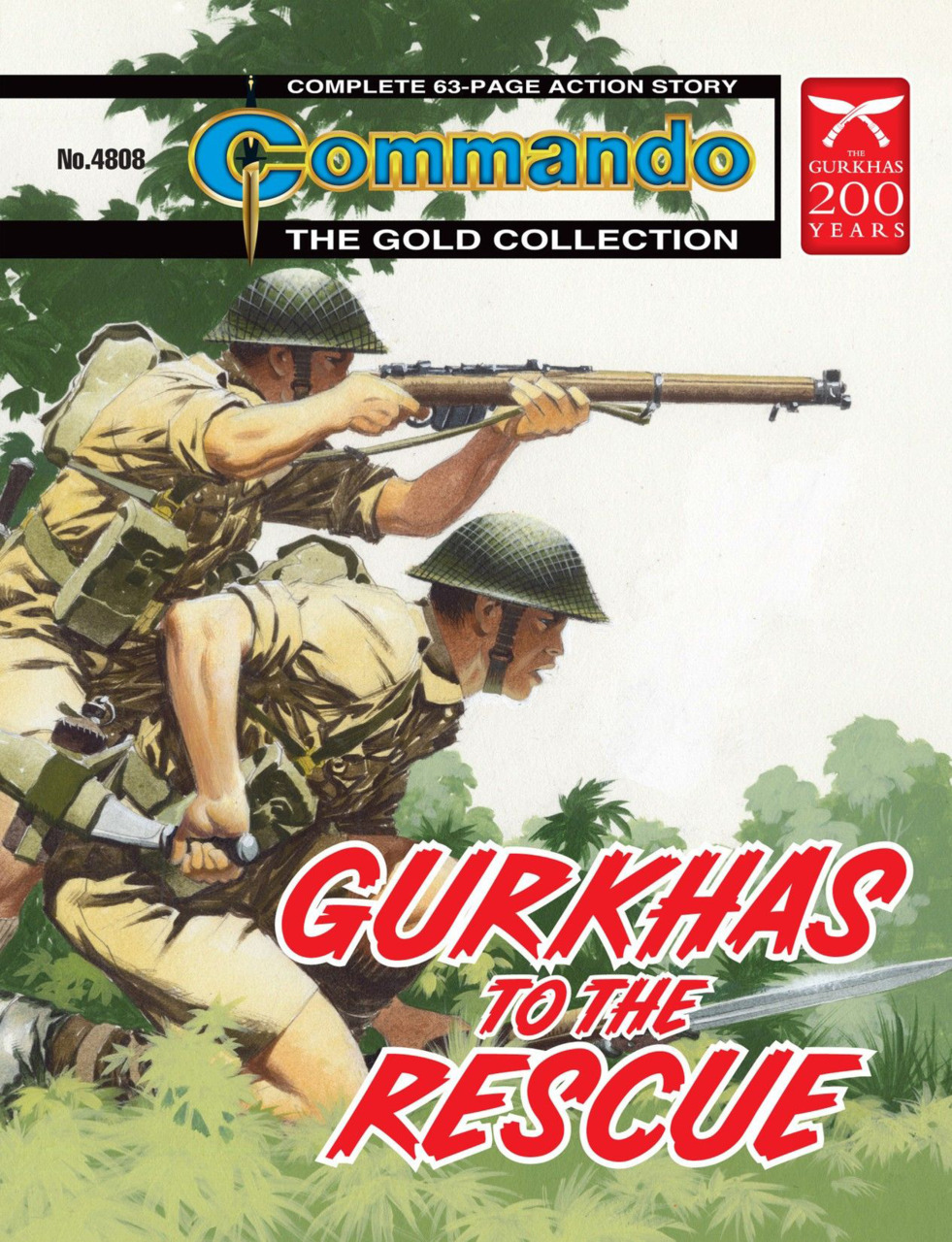
Commando: For Action and Adventure #4808 Gurkhas To the Rescue
Cover Date: May, 2015
A figure moved silently in the darkness of the jungle clearing…then another - and moments later two sentries fell unconscious without a sound. Swiftly the intruders stepped over the inert bodies and through the door of the now unguarded hut. But these ...
Issue Description
A figure moved silently in the darkness of the jungle clearing…then another - and moments later two sentries fell unconscious without a sound. Swiftly the intruders stepped over the inert bodies and through the door of the now unguarded hut. But these attackers wore the same uniform as the sentries and they were in the same army. What on earth was going on?
Believe it or not, it all started when the night express to Glasgow crashed in November 1922…
Introduction
Gurkhas were first recruited into British service in 1815, following the closely-fought Anglo-Nepal wars between the East India Trading Company and the recently-unified Kingdom of Nepal. Soldiers are traditionally recruited from hill villages across Nepal and each year thousands of applicants compete in a gruelling selection for the chance to become part of the British Army. Amongst stringent academic and fitness tests the most infamous part of the selection is the 'Doko Race' which involves a 5km uphill run, carrying 25kg in a basket secured around the head.
Gurkha soldiers are world-renowned for their fitness, discipline, courage and the curved 'kukri' knife which they carry. The Brigade's motto is 'It is better to die than live a coward' and they have won 26 Victoria Crosses; of these 13 have been awarded to British Officers and 13 have been awarded to Nepali soldiers (who only became eligible for the award in 1911).
The first regular Gurkha units of the British Army distinguished themselves fighting for the East India Trading Company and the Crown; and during the Indian Mutiny remained loyal and fought alongside British soldiers to successfully quell the rebellion. For their part in this, the Sirmoor Regiment were permitted to adopt the traditions and dress of the British light infantry and later awarded the Queen's Truncheon. The Truncheon replaced the existing Colours and is accorded the honours due to a Queen's Colour; it is unique within the British Army and continues to be carried by the Royal Gurkha Rifles.
By the First World War, there were ten full-strength Gurkha regiments in the British Indian Army and the 100,000 men who served with them between 1914 and 1918 saw action in France, Flanders, Mesopotamia, Persia, Egypt, Palestine, Salonika, and Gallipoli.
In the Second World War there were no fewer than 40 Gurkha battalions in British service and the whole of the Nepali Army was put at the disposal of the United Kingdom. Gurkha battalions fought in Italy and North Africa and a number of regiments were part of the 'Forgotten' XIVth Army in Burma, often employed on Chindit operations.
Following Partition in 1947, four Gurkha battalions of the British Indian Army were transferred to the British Army's Gurkha Brigade and moved to the Far East where they became expert in jungle warfare and served with distinction in various campaigns. After the Handover of Hong Kong the Brigade relocated to the United Kingdom. One battalion of the Royal Gurkha Rifles is permanently stationed in Brunei.
Today the Brigade of Gurkhas consists of around 3000 soldiers in two battalions of the Royal Gurkha Rifles, the Queen's Gurkha Signals, Queen's Gurkha Engineers, Queen's Own Gurkha Logistic Regiment, Gurkha Staff and Personnel Support Company, the Band of the Brigade of Gurkhas and Headquarters Brigade of Gurkhas. Since the Second World War, Gurkha units have deployed to Malaysia, The Falklands, Bosnia and Kosovo, Sierra Leone, Macedonia, East Timor, Iraq and Afghanistan; both as formed units, and to reinforce other units of the British Army. The Nepalese Army and the Indian Army also employ Gurkhas.
Jai Gurkha!
Note: Originally published as Commando No 1225 (1978).
Commando: For Action and Adventure (1993)
- Publisher
- D.C. Thomson & Co.
Volume Description
British company D.C. Thomson & Co. began publishing Commando: War Stories in 1961 mostly focusing, as the name hints, on war stories from WWII and WWI respectively. This was extended to other wars and conflicts later on and since 1993, beginning with issue #2691, the series was called Commando: For Action and Adventure.
Currently D.C. Thomson publishes four issues a fortnight (eight issues a month).
The Gold Collection and Silver Collection content reprints of older stories
Home of Heroes focus on new stories about British Arm Forces
Action and Adventure focus on new stories set around the world
Format: 7 x 5.5 inch (17,75 x 14 cm); 68 pages; b/w sketches only.
Please first Sign In before leaving a review.